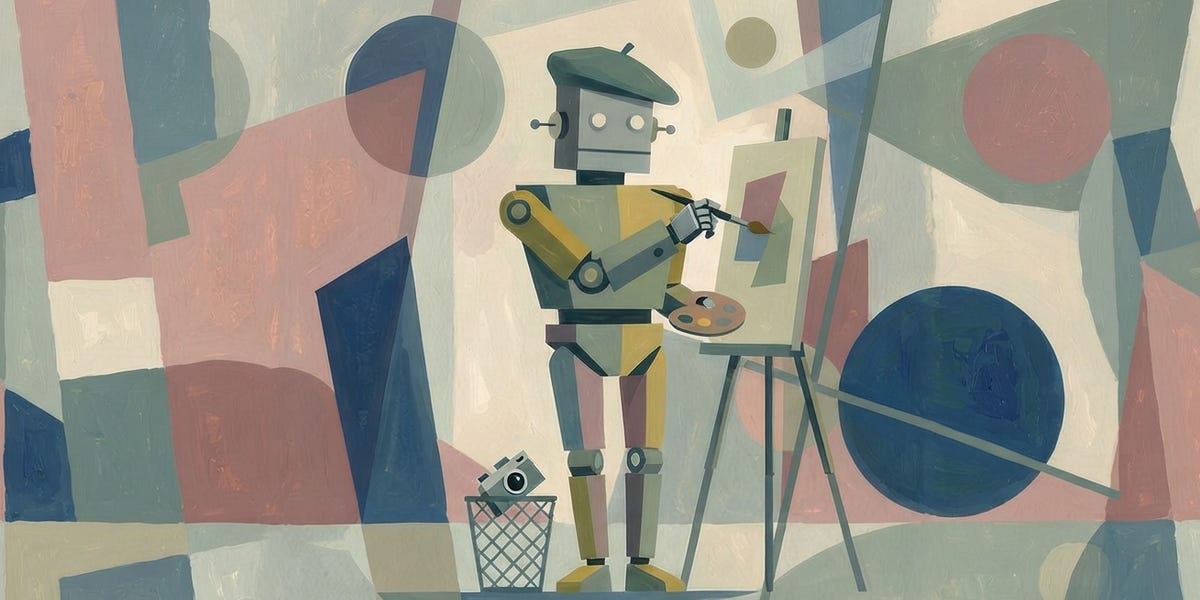
Since we’re on the topic of talks, I wanted to describe my process for generating the illustrations I use for my slides. Two years ago I primarily used royalty-free stock photography, but now I use images generated by AI (first via ChatGPT but now with Gemini). Over that time my workflow has evolved substantially, and I think it’s reached the point where others might find it interesting and useful. (View Highlight)
Let’s begin with the big picture: I use AI to generate illustrations, not photos or diagrams. I don’t think AI-generated photos are appropriate for a presentation; at best they’re misleading and at worst they’re flat-out creepy. As for diagrams, I just don’t think that AI is (yet) up to the challenge. AI-produced diagrams tend to be overly complex, and while they look impressive, they tend not to aid comprehension of complex topics. And worse, they’re not editable: you can’t nudge a box or reword a label. So instead of just fixing the problem, you end up in a frustrating loop of prompt tweaking, trying to coax the image towards the diagram you could have drawn yourself much faster. (View Highlight)
For me, illustrations are the sweet spot of AI-generated art. A good illustration doesn’t need to explain anything — it evokes a feeling, an image, or a memory in your audience’s mind. It supports your presentation, rather than overshadowing it, freeing the audience to focus on the most important thing: you and what you’re saying. (View Highlight)
For me, right now, Google’s Gemini Image family (aka Nano Banana) is the best model for generating images. It’s widely available, high quality, reasonably fast, and reasonably cheap. While you can of course create images using chat, I think there’s a better way. A way that’s both reproducible and reusable, facilitated by a small R package called bananarama. (View Highlight)
You can’t generate art with AI without thinking about the artists. These models are trained on images scraped from the internet without artists’ consent, and the fact that I find them so useful doesn’t make that go away. I wish I had a tidy resolution; I don’t. Art is important to me, and I like to surround myself with beautiful things made by people. I don’t know if that feels like enough, and it didn’t feel right to talk about this workflow without touching on the uncomfortable parts. (View Highlight)