Metadata
- Author: Fabien Girardin
- Full Title: Writing With Probabilistic Machines
- URL: https://girardin.medium.com/writing-with-probabilistic-machines-3a5bc69ffab9
Highlights
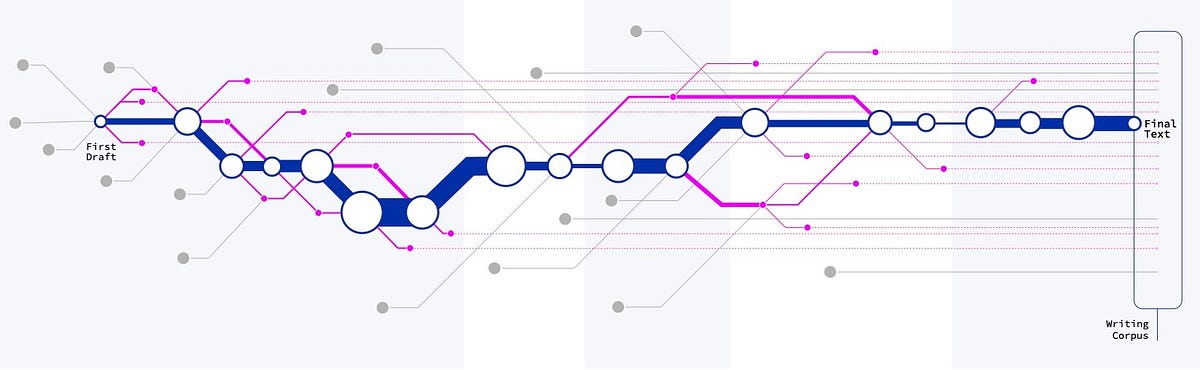
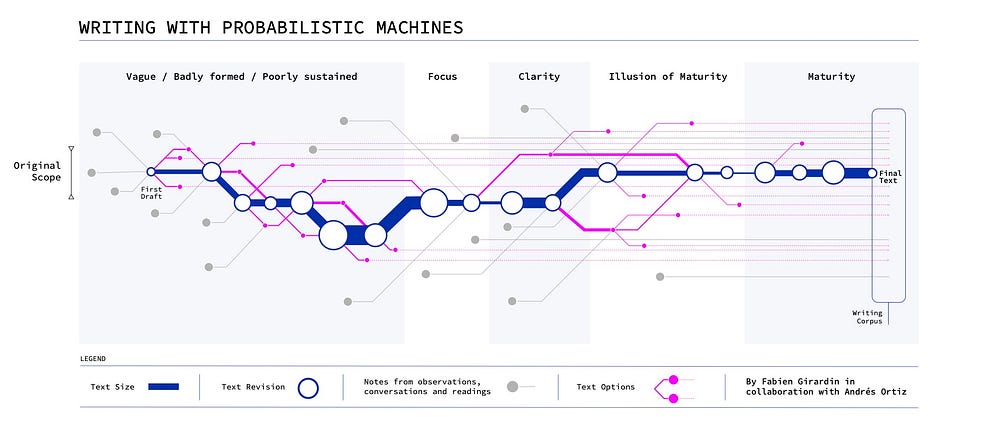 If I had to illustrate my writing trajectory for this text, it would resemble a wandering line slowly gaining definition. In the diagram above, the blue line marks how the text evolved as a living document through successive revisions, moving from vague fragments toward clearer, more mature thoughts. The light grey lines represent notes from observations, readings, and conversations that intersect with AI-assisted articulations in pink. Together, they form an exploratory path that splits into multiple tracks, loops back, and eventually converges. What begins with a narrow scope widens into not just a finished text, but a broader landscape of thinking that only emerges through the act of writing. (View Highlight)
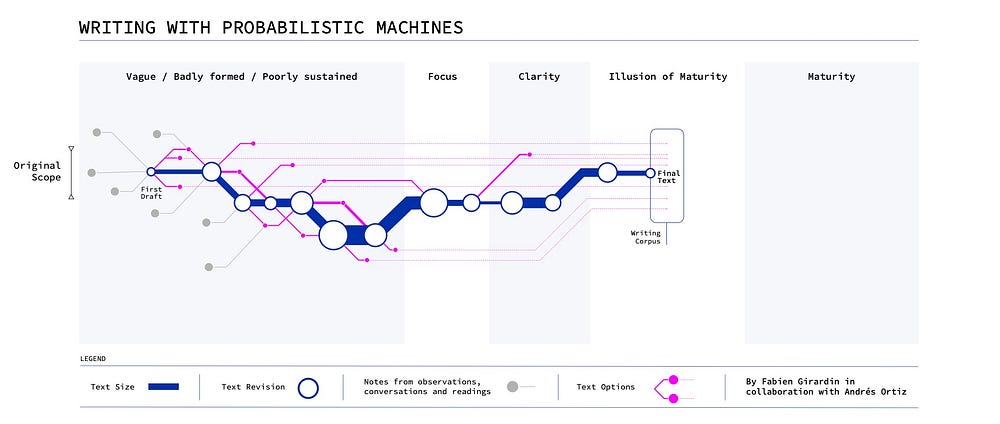 The trajectory jumps quickly toward apparent clarity and an “illusion of maturity”, as AI tools help me smooth sentences, tighten structure, and define boundaries. Yet the scope of the writing corpus remains relatively narrow. The final text appears complete and mature, but represents what I lose: the deeper, more erratic thinking that comes from wrestling with ideas outside the context of the interaction with a probabilistic machine. (View Highlight)
- I come from an engineering and research background, where structure, precision and clarity matter above all. But I have always been drawn to great storytellers (e.g. novelists, history popularizers, comedians, science communicators). There’s something almost magical about their ability to weave ideas into compelling narratives. My own writing has always been more pragmatic: detailed specifications, internal notes synthesizing multiple perspectives, documents laying out a vision, research papers sharing results of experiments. Over the last twenty years, I learned that the person who writes things down holds a particular kind of power. The power to shape how ideas spread and take root both in my own mind and with others when I share them. (View Highlight)
- For me, writing has never been comfortable because I write to think. Writing forces my mind to meet reality: to capture multiple points of view, to form an opinion, to articulate a perspective. Without writing, my ideas remain vague, badly formed, and poorly sustained. (View Highlight)
- I often share short texts (like this one) with a colleague for a quick review and sometimes I link them to publish an essay, to structure a class, or to give a public presentation. But mostly, I accumulate stacks of half-baked drafts that serve as notes for ongoing thinking. Until recently, this was largely a solitary struggle. It still is at its core. The thinking, the choosing, the crafting of ideas remain mine alone. But the surface of writing, the articulation itself, has changed. (View Highlight)
- With the arrival of Generative AI tools, some parts of my writing process take place via a messaging interface. Some call it “vibe writing”. Suddenly, I could engage in a dialogue about my ideas, testing different ways to articulate them, and helping me when I get stuck. For someone who struggles with storytelling, this felt revolutionary. I had a tool to help translate a messy train of thought in my head into fluid, readable texts, almost like a storyteller. (View Highlight)
- I lean on the popular general-purpose LLMs (e.g. ChatGPT and Claude) to polish the flow of my thoughts and AI wrappers (e.g. Perplexity) to find references and novel research material. I use these tools to integrate my notes, find the boundaries of my text and to better position my thoughts. They prove particularly useful to prevent me from “Magnum Opusing”: that familiar trap where the scope expands endlessly, and notes accumulate until the project becomes too complex to ever complete. (View Highlight)
- This diagram mirrors my other creative work in software engineering and futures design, where Generative AI tools have amplified my capabilities. I have been vibe coding ideas and prototyping concepts without deep knowledge of the latest software libraries or fluency in certain programming languages. (View Highlight)
- Having spent years creating software and envisioning futures, I have learned to watch carefully for what we might lose in what we gain. In 1964, Marshall McLuhan argued in Understanding Media, that technology and society co-evolve: every augmentation is also an amputation. (View Highlight)
- LLMs have undeniably lowered the barriers to writing. Many people can now share their thoughts with more confidence, even when writing in a foreign language (like me now). Something that would have been unimaginable just a few years ago. We worry less about grammar and form as these feel “easily” fixable by an AI writing tool. Or is it an illusion of confidence? (View Highlight)
- Loss of authenticity My experience of outsourcing writing often leads to safe, predictable prose; instead of pushing the limits of my original thought. If I am not careful, my ideas fade and become average. They are stripped of personal nuances, they lose their wabi-sabi and soon are no longer authentic. When approached superficially, writing with AI can easily regress thought to a statistical middle ground. (View Highlight)
- Flawed reasoning Generative AI tools rush toward conclusions and good enough solutions, sometimes introducing illogical shortcuts. They produce plausible, compelling, confident prose that can camouflage flawed reasoning. These biases are features of the stochastic probabilistic models used in Generative AI. They are not a bug that will go away soon. As a result, I get caught in the constant effort to reappropriate the ideas, to make them my own again. (View Highlight)
- Shallow thinking Finally, thinking is not linear as a conversation via a messaging interface. It is often erratic and messy. To grow stronger, ideas require exposure to different perspectives and the discipline of battling through them. They need time to mature. The quick-fix nature of current Generative AI tools is undeniably useful, yet it also reflects today’s shortcut culture, tempting us to bypass the kind of painful intellectual work that produces truly original and deep thoughts. (View Highlight)
- Beyond my work, I have noticed the “illusion of maturity” in some students’ final projects and in the AI-generated content shared on LinkedIn, Medium and in blogs. Some recent studies seem to confirm these observations (e.g. Your brain on ChatGPT) though the research remains early and findings should be interpreted cautiously. The underlying driver appears to be our natural human preference for fast thinking, which is easier and requires fewer resources.. (View Highlight)
- To write this text, I wanted to counterbalance my use of Generative AI tools with more human frictions. I ran a small experiment in the format of a tertulia. A concept originally from Spain, a tertulia describes a regular social gathering of people to share their recent creations and talk about current affairs. These gatherings, also called cénacle in France or salon.) in the English-speaking world, have long been spaces where ideas develop through human connection. (View Highlight)
- Practically, once a week, I brought together 4–6 colleagues (known as tertulianos) for a 1-hour online discussion. Each of us brought something in progress, a draft, a project, an outline for a presentation, readings, etc. We all use AI tools regularly, but the tertulia became a place to reflect and to let our ideas mature outside the rush of work. (View Highlight)
- The sessions felt like having a “writing circle” that only popular storytellers or comedians have the luxury to have. We bounced ideas back and forth, challenged each other, and offered perspectives none of us would have reached alone or with a tool. My role was to encourage these frictions, to provoke collisions, to keep the conversation difficult enough to spark new thinking. It was erratic. It was fun. (View Highlight)
- After each session, I found myself immersed in notes from our conversations, along with related observations and readings. Each session challenged and deepened my thinking about “writing to think.” I was struggling to write this very text, and that struggle felt right. It pushed my ideas past the “illusion of maturity” in ways that happened entirely outside of AI tools. (View Highlight)
- The heart of the writing process, the unexpected insights, the feeling of getting lost, the obscure cultural references, the inspiring analogies, the real leaps of imagination emerged from social interaction. Laurent articulated the constant struggle to reappropriate ideas from AI tools. Andrés introduced the concept of ‘shortcut culture’ developed by Carolina Sanín. Lisa drew connections to the book Thinking, Fast and Slow. My notes overflow with these breakthroughs, each one sparking new connections in my own mind. (View Highlight)
- This text emerged from exactly the practice it describes: conversations with machines for focus and clarity, conversations with humans for maturity and depth. The design objective is not to replace the struggle of writing, but to make it more fertile. It points toward a larger question about how we collectively navigate our relationship with AI tools. (View Highlight)
- One quote captures well this current co-evolution between machines and humans:
“The rapid spread of AI adoption is made possible through human collaboration.” (View Highlight)
- It comes from my friend and accomplice Lisa Gansky, a member of the tertulia. Serial entrepreneur and author of The Mesh, Lisa knows what she is talking about. She is an expert on technology, collaboration and networks. Together, we share a concern: when speed replaces depth, something is lost in what makes us humans both as professionals and as citizens. (View Highlight)
- Deep and authentic thinking demands time, curiosity, vulnerability, and willingness to sit with questions. As Lisa often says, it is not a “spectator sport.” Thinking requires active making (e.g. writing, sketching, prototyping) to develop and practice the skills at its core. (View Highlight)
- The tertulia experiment shows that anyone could benefit from it. But today’s frenetic AI world needs more than occasional experiments. It needs a community of practice for this kind of slow and deliberate thinking. This is exactly what Lisa and I are pursuing at Próximo Lab: a space where a community of perpetual learners from diverse backgrounds immerse and engage with each other through tertulias and other collaborative explorations (e.g. hands-on studios, guest talks, etc). We see this type of trusted, diverse learning lab as a foundational element for our lives. (View Highlight)