On Tuesday, April 1st, Oracle executed what analysts are already dubbing the largest layoff in its history. Between 20,000 and 30,000 people woke up to a 6:00 a.m. email. No heads-up from HR, no warning from managers. While it was an open secret brewing for days, the execution was brutal. (View Highlight)
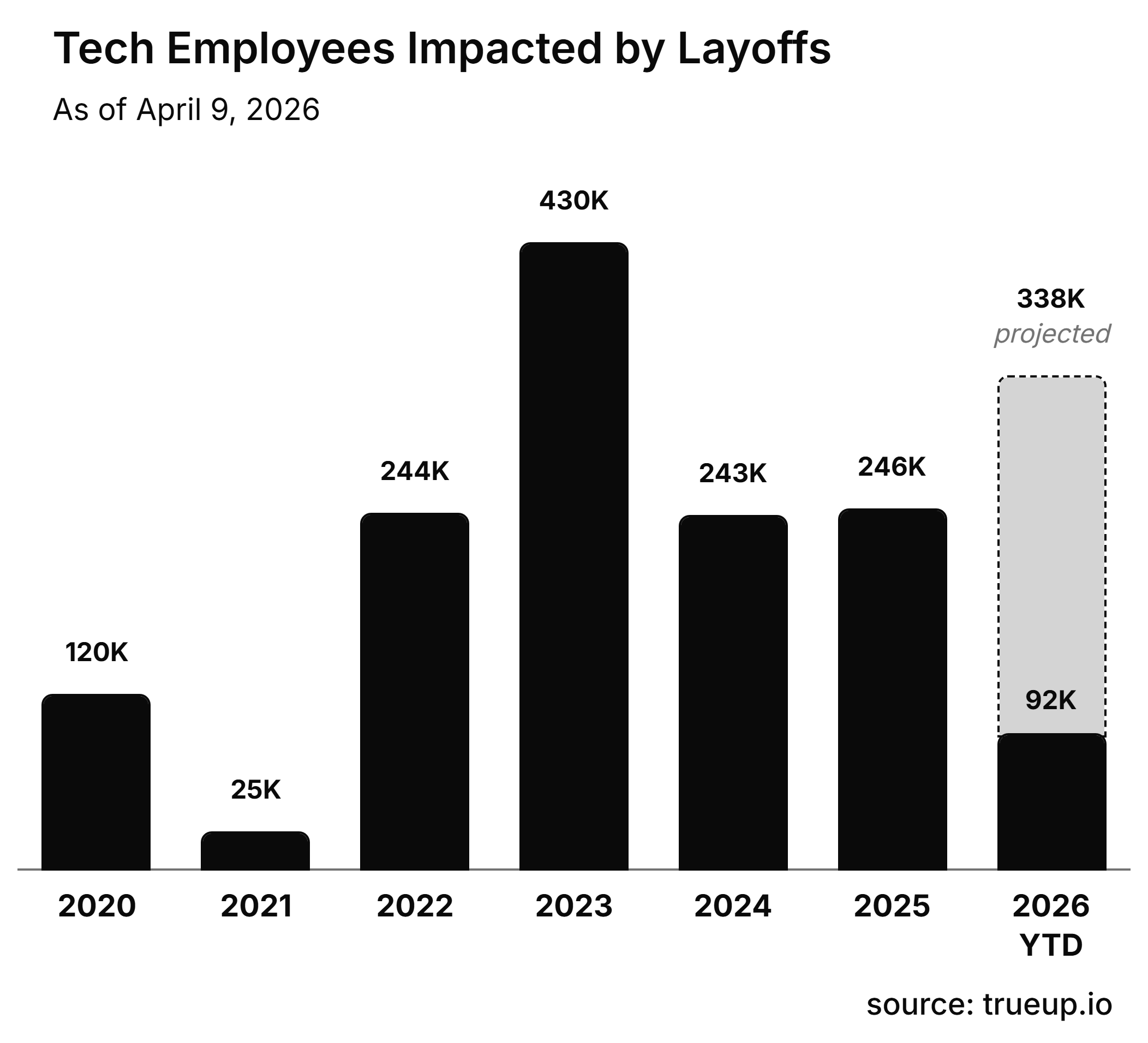
On that same day, those numbers were added to the grim running total of Q1 2026 layoffs at major US tech giants: Amazon, Meta, Microsoft, Block, Salesforce, Epic Games… tens of thousands of jobs evaporating in a matter of months. (View Highlight)
The headlines practically write themselves (and many already have): Tech jobs are plummeting. (View Highlight)
On that very same Tuesday, April 1st, Daniel Blanco tweeted that his MongoDB team was hiring again for a new hub in Dublin. Miguel Carranza from RevenueCat published a simple “we are hiring” with a link to their open roles. Just like that, dozens of other companies posted job openings. But nobody reported on those. (View Highlight)
We are seeing companies laying off workers while hundreds of others are aggressively hiring. Even wilder: some companies executing layoffs have hundreds of open requisitions at the exact same time. Paradoxical, right? As always, the reality of the tech market is far more complex than a clickbait headline. (View Highlight)
According to BLS data, since its peak in November 2022, the IT sector has lost 330,000 jobs, dropping to 2.79 million, its lowest level since mid-2021, dipping below pre-pandemic levels. That’s two consecutive years of contraction. (View Highlight)
TrueUp, tracking over 9,000 tech companies, just reported more than 67,000 active software engineering job postings—the highest level in three years, nearly doubling the mid-2023 low point. Postings are up 30% in Q1 2026 alone. (View Highlight)
The exact same TrueUp report tracking 67,000 open roles also recorded 52,000 announced layoffs in Q1. The same quarter, the same sources, the same sector. Employment drops, layoffs hit, yet job offers surge. (View Highlight)
This paradox isn’t a glitch in the data matrix. It is the most accurate snapshot of the 2026 tech ecosystem: a sector aggressively destroying one type of role while simultaneously creating another, fast enough for both curves to coexist. There is no single truth. The jobs being destroyed are morphing into new roles and new business needs. Understanding this nuance is the only way to navigate this market without being swayed by the noise. (View Highlight)
Translation: We’ve calculated (on spreadsheets, not necessarily in the trenches) that we need fewer people to maintain output, and we desperately need that payroll cash for GPUs and data centers. (View Highlight)
Jobs aren’t always lost: in some cases, they simply shift geographically, seeking 60-70% lower costs. Many of these hires are based in India (and some layoffs are also done there). (View Highlight)
While Big Tech reorganizes, the rest of the world hasn’t stopped building. A structural divide is defining the 2026 market. It’s no longer just about startup vs. enterprise; it’s about companies that use AI as a tool vs. companies born as AI-native. (View Highlight)
We are looking at a 10x to 20x multiplier in human productivity. A 30-person AI-native startup now has the operational firepower and market reach of a 300-person traditional company. (View Highlight)
This doesn’t mean they aren’t hiring. It means they are hiring differently: fewer overall headcounts, higher seniority, and a strict demand for professionals who know how to multiply their output using AI agents, rather than just using LLMs as glorified spellcheckers. (View Highlight)
The VC money is still flowing heavily. February 2026 broke the all-time monthly record with $189B invested globally in just 28 days. That capital is going to companies that are actively building and hiring. (View Highlight)
Alright Borja, the US data is great, but what about Spain? Understanding that the Spanish ecosystem plays by its own rules is crucial, even if global macroeconomic waves always hit our shores. And right now, local data directly challenges the catastrophism: (View Highlight)
Let’s look at Oracle again. It’s the most extreme recent example, and it perfectly illustrates the mechanics behind mass layoffs in this current cycle.
Oracle just released its Q3 results: [**6.13Binnetprofit(up95523 billion, a staggering 433% increase. This is not a company in crisis.
So why lay off 30,000 people? Because Oracle has committed 156billiontoAIdatacenterinfrastructureandtakenonover100 billion in debt to finance it. They need to free up 8Bto10B in cash flow currently tied up in payroll. The co-CEO translated this corporate strategy bluntly: “The use of AI-powered coding tools allows smaller teams to deliver more complete solutions faster.” (View Highlight)
The company isn’t collapsing; they are aggressively redirecting capital from human infrastructure to hardware infrastructure. Confusing the two causes market panic.
The same logic applies to much of the “Magnificent 7”, Apple, Microsoft, Google, Amazon, Meta, Tesla, and NVIDIA. They over-hired during the ZIRP (Zero Interest-Rate Policy) era of 2020-2022 when money was free, and now they are correcting those excesses while shifting budgets to AI compute power.
Hiring Trends in big tech in USA (View Highlight)
But specific cases speak louder than macro aggregates. Let’s look at who is hiring right now:
• Multiverse Computing: Opened a Barcelona hub in March (joining Madrid and Zaragoza). Backed by a €189M Series B, they just hired 90 people (Presales Engineers, PMs, ML Engineers, AI Researchers) and are pushing past 100 employees in BCN alone.
• THEKER Robotics: Closed the largest seed round in Spanish history ($21M) for AI-powered industrial automation. Actively seeking Engineering and GTM profiles.
• HappyRobot: Founded by Spaniards, backed by a16z. Scaled from 0 to 130 employees rapidly, recently expanded a DHL partnership, and is hiring tri-lingual Forward Deployed Engineers.
• Hoople: Based in Tres Cantos, raised €130M to build a terrestrial intelligence platform with Microsoft as a strategic partner.
• Factorial: Continues to be a dominant force in the Spanish startup scene, constantly opening both technical and commercial roles. (View Highlight)
None of these companies made the viral layoff tweets. They are all scaling. Spain is cementing itself on the map as a highly relevant tech hub with a heavy international focus.
Does this mean no companies died? Of course not. Startups failed to raise their next rounds. Some lost their entire product moat overnight because OpenAI or Anthropic released a new core feature. The market is ruthless, but stronger, more resilient companies are rising in their place.
Here is the final paradox, and it’s something we see every single day at Manfred: There are more CVs in circulation than two years ago, yet it’s significantly harder to fill certain technical roles. (View Highlight)
AI has fundamentally changed what companies expect from a Senior Developer in just 18 months. They aren’t just looking for someone who writes clean code. They are looking for someone who can write clean code AND orchestrate AI agents AND operate with deep autonomy in micro-teams AND systematically delegate repetitive tasks to LLMs to focus purely on high-judgment engineering.
This specific profile is relatively new. There is no massive, legacy database of candidates with 5 years of experience doing this.
Simultaneously, the traditional job application process has broken down. LinkedIn is a jungle of noise. Any decent remote job posting gets hit with hundreds of applications in hours, many of them auto-generated by AI bots. (View Highlight)
The result? The signal-to-noise ratio is destroyed. There is immense talent in the market, but for senior candidates, the sheer volume of automated spam makes it incredibly difficult to stand out organically. In fact, 65% of tech hiring managers report that finding qualified professionals is actually harder now than it was a year ago.
The roles being heavily impacted by layoffs (juniors, manual QA, standard frontend, etc.) are completely different from the roles companies are desperately trying to fill (AI-integrated systems engineers, data architects). Treating them as the exact same market is the biggest analytical error happening on “Tech” Twitter right now. (View Highlight)
I don’t want this to be a “this is fine” meme article. Everything is not fine.
The 30,000 Oracle employees laid off are real people facing real anxiety. We cannot, and should not, expect a return to the 2022 tech theme park, that was an artificial reality sustained by zero-interest rates.
What I do want this article to be is an accurate lens to read the market. Because poor market analysis leads to poor career decisions by candidates, and poor hiring strategies by HR teams.
At Manfred, our own data backs up our optimism. Our business pipeline is significantly stronger than in 2024 or 2025. Q1 2026 has been our best quarter in revenue since 2023. More companies are knocking on our door to build tech teams. Call it luck, call it noise, or call it a leading indicator. With our bias declared up front, we’ll let you decide. (View Highlight)
 (View Highlight)
 (View Highlight)
 (View Highlight)
 (View Highlight)
 (View Highlight)
 (View Highlight)
 Reddit post about Oracle layofss (View Highlight)
 Tuomas Artman tweet (View Highlight)
 Hiring Trends in big tech in USA (View Highlight)
 (View Highlight)