Metadata
- Author: Packy McCormick
- Full Title: The Company as a Machine for Doing Stuff
- URL: https://www.notboring.co/p/the-company-as-a-machine-for-doing
Highlights
- Forrest loves building infrastructure. It is the thing that he would do if he could retire tomorrow. But if he retired tomorrow, he would have to start over from scratch; he would be less able to do the things he wants to do. He is building the company to do those things, bigger than he could alone, with other people who want to do them, too. (View Highlight)
- I think when people get frustrated with the modern instantiation of Y Combinator, and with Silicon Valley more broadly, it’s because they know that there are not dozens of 19-year-olds so obsessed with automating away customer service jobs that they would do it in retirement. Most startups are vehicles for status and wealth, vehicles to accumulate the resources people think they need to do what they actually want to do or work on the thing they actually want to work on, if they even have any idea what that thing might be. (View Highlight)
- Last week, Brie Wolfson published an essay about her two months working inside of the AI coding startup Cursor, which she concluded with:
Perhaps my best evidence that the prize is the mission is that during my fall at Cursor, I overheard zero chatter from employees about getting rich. At Stripe and Figma (and most other startups), this was a favorite lunch table topic among the first few hundred employees at a decacorn. Yet at Cursor, as the valuation goes up and up, I haven’t heard a peep about the second homes people will buy, the great-great-grandchildren that will be put through college, or the time they’ll take off traversing the world. If people have dollar signs in their eyes, they’re not talking about it much. And I think it’s because the thing most of them would do if they could retire tomorrow would be whatever they’re doing now at Cursor. (View Highlight)
- If you won a billion dollars in the lottery tomorrow, would you fuck off to a beach, do something else you actually want to be doing, or roll the billion dollars into doing the thing you’re already doing bigger, faster, and better? In Brie’s phrasing, would the people working at a company be working there if they could retire tomorrow? (View Highlight)
- Elon Musk is the canonical example here. He rolled his Zip2 and PayPal winnings into Tesla and SpaceX, at the risk of personal bankruptcy, because work was more important than the financial rewards. The money was useful in bringing together other people who also wanted to do the work. (View Highlight)
- This is an obvious thing to note, but worth noting: Elon Musk didn’t take his money, buy a big garage and a bunch of parts, and start tinkering away on electric cars and rockets by himself. He started companies, and hired people with the skills necessary to do the work at the scale required, many of whom would do what they did at Tesla and SpaceX if they could retire tomorrow. He wants to take humanity to Mars. He can’t do that alone. (View Highlight)
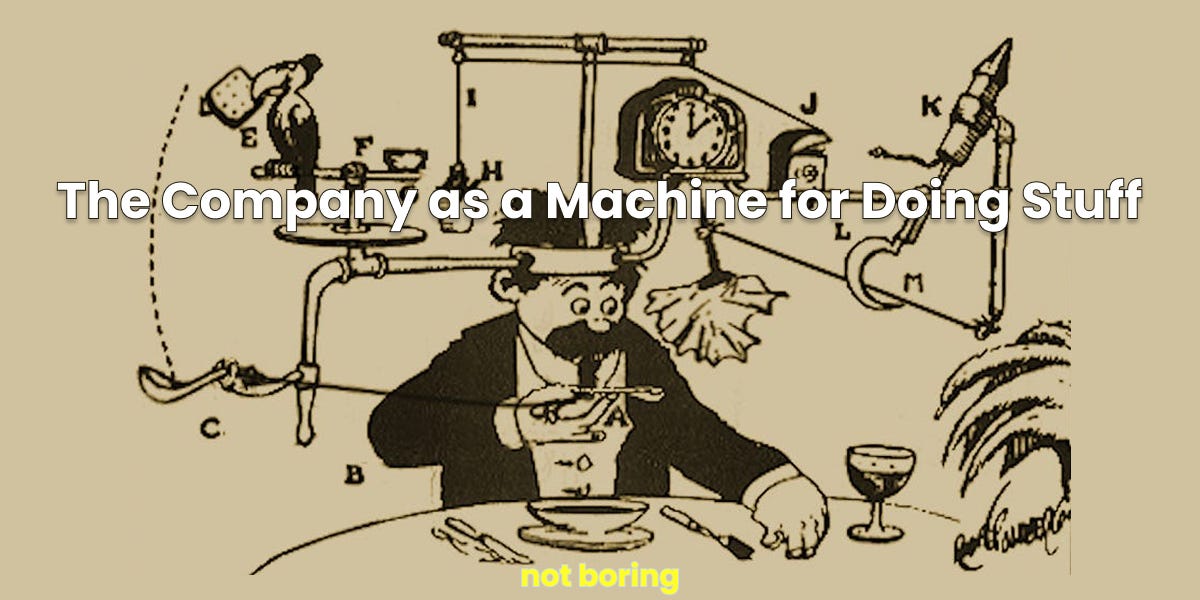
- At their best, companies are machines for doing the stuff a founder really wants to do, but bigger, with other people who want to do it too. (View Highlight)
- The longer I spend investing in and writing about startups, the more I think my job should just be to find the small handful of people who view their companies like Forrest does, and then put as much money and effort as I can behind them to help them build their machines. (View Highlight)
- Pretty much all Astro Mechanica founder Ian Brooke has ever wanted to do is build and fly fast planes. He’s built or owned like eighteen of them, on his own dime. But to build a supersonic plane, which takes a lot of very smart people, billions of dollars, and many years, he started a company. (View Highlight)
- The thing that you’re trying to use your company vehicle to accomplish doesn’t have to be a lifelong passion like infrastructure has been for Forrest, planes have been for Ian, or networking has been for Anil and Sunil. Elon didn’t dream of electric cars as a young boy in South Africa. But it does have to be big enough to remain endlessly fascinating and continue to expand for the decades it takes to build something truly important. (View Highlight)
- You have the right to work only but never to its fruits. Let not the fruits of action be your motive, nor let your attachment be to inaction. (View Highlight)
- Most people work for the fruits. It is rare to find people who work for the work itself. Rarer still is to find the situation Brie found at Cursor: a group of people working for the work itself, together, in order to do greater work together than they could alone. (View Highlight)