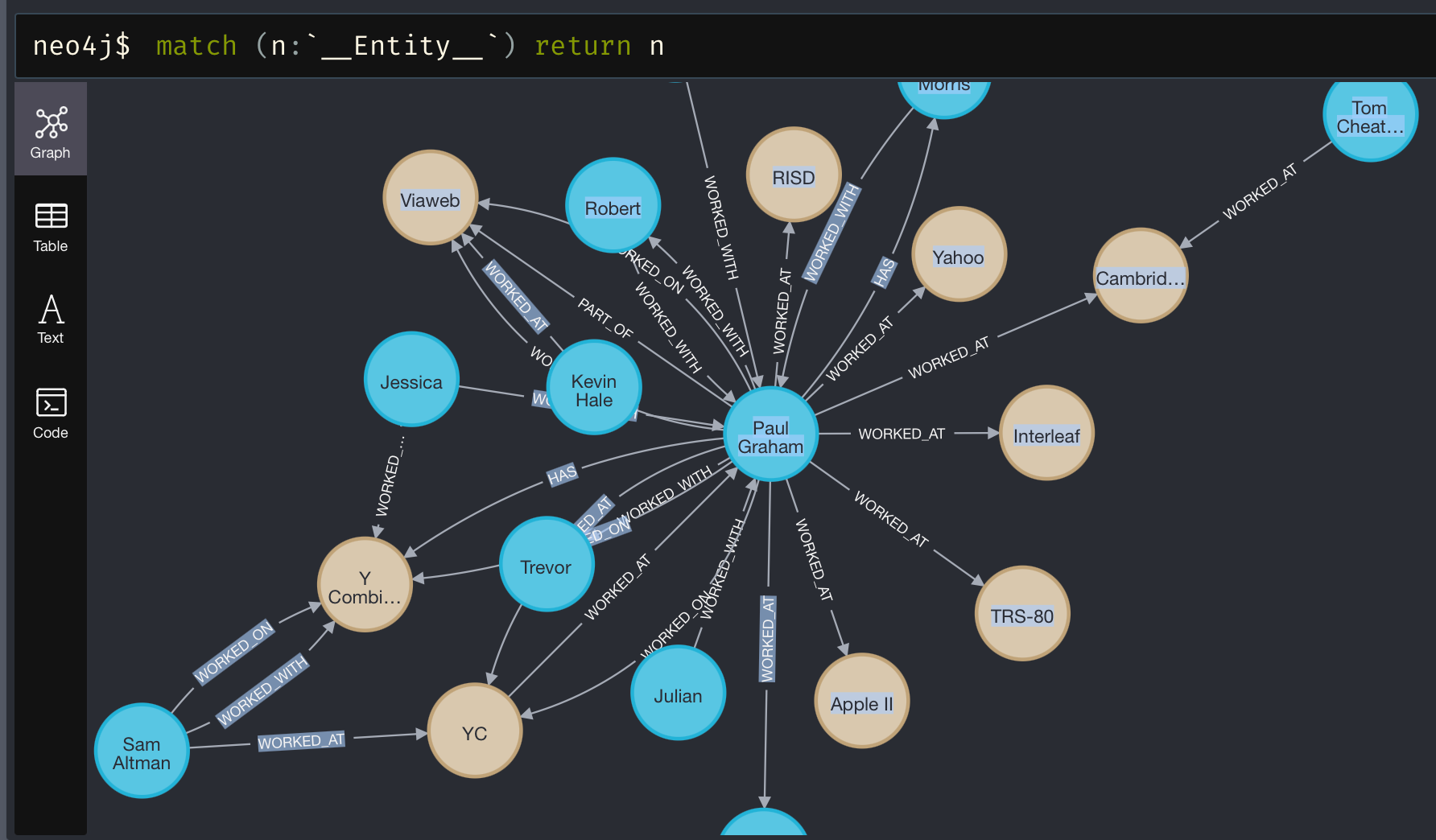
We’re thrilled to announce a new feature in LlamaIndex that expands our knowledge graph capabilities to be more flexible, extendible, and robust. Introducing the Property Graph Index! (View Highlight)
The Property Graph Index solves these issues. By using a labeled property graph representation, it enables far richer modeling, storage and querying of your knowledge graph. (View Highlight)
The Property Graph Index offers several ways to extract a knowledge graph from your data, and you can combine as many as you want: (View Highlight)
1. Schema-Guided Extraction: Define allowed entity types, relationship types, and their connections in a schema. The LLM will only extract graph data that conforms to this schema. (View Highlight)
2. Implicit Extraction: Use LlamaIndex constructs to specify relationships between nodes in your data. The graph will be built based on the node.relationships attribute. For example, when running a document through a node parser, the PREVIOUS, NEXT and SOURCE relationships will be captured. (View Highlight)
3. Free-Form Extraction: Let the LLM infer the entities, relationship types and schema directly from your data in a free-form manner. (This is similar to how the KnowledgeGraphIndex works today.) (View Highlight)
By default, all graph nodes are embedded. While some graph databases support embeddings natively, you can also specify and use any vector store from LlamaIndex on top of your graph database. (View Highlight)
The Property Graph Index supports a wide variety of querying techniques that can be combined and run concurrently. (View Highlight)
1. Keyword/Synonym-Based Retrieval: Expand your query into relevant keywords and synonyms and find matching nodes. (View Highlight)
2. Vector Similarity: Retrieve nodes based on the similarity of their vector representations to your query. (View Highlight)
3. Cypher Queries: Use the expressive Cypher graph query language to specify complex graph patterns and traverse multiple relationships. (View Highlight)
Under the hood, the Property Graph Index uses a PropertyGraphStore abstraction to store and retrieve graph data. You can also use this store directly for lower-level control. (View Highlight)
Traditional knowledge graph representations like knowledge triples (subject, predicate, object) are limited in expressiveness. They lack the ability to:
• Assign labels and properties to nodes and relationships
• Represent text nodes as vector embeddings
• Perform both vector and symbolic retrieval (View Highlight)
With Property Graphs, you can:
• Categorize nodes and relationships into types with associated metadata
• Treat your graph as a superset of a vector database for hybrid search
• Express complex queries using the Cypher graph query language
This makes Property Graphs a powerful and flexible choice for building knowledge graphs with LLMs. (View Highlight)