Over the past month, we’ve been looking into reports that Claude’s responses have worsened for some users. We’ve traced these reports to three separate changes that affected Claude Code, the Claude Agent SDK, and Claude Cowork. The API was not impacted. (View Highlight)
On March 4, we changed Claude Code’s default reasoning effort from high to medium to reduce the very long latency—enough to make the UI appear frozen—some users were seeing in high mode. This was the wrong tradeoff. We reverted this change on April 7 after users told us they’d prefer to default to higher intelligence and opt into lower effort for simple tasks. This impacted Sonnet 4.6 and Opus 4.6. (View Highlight)
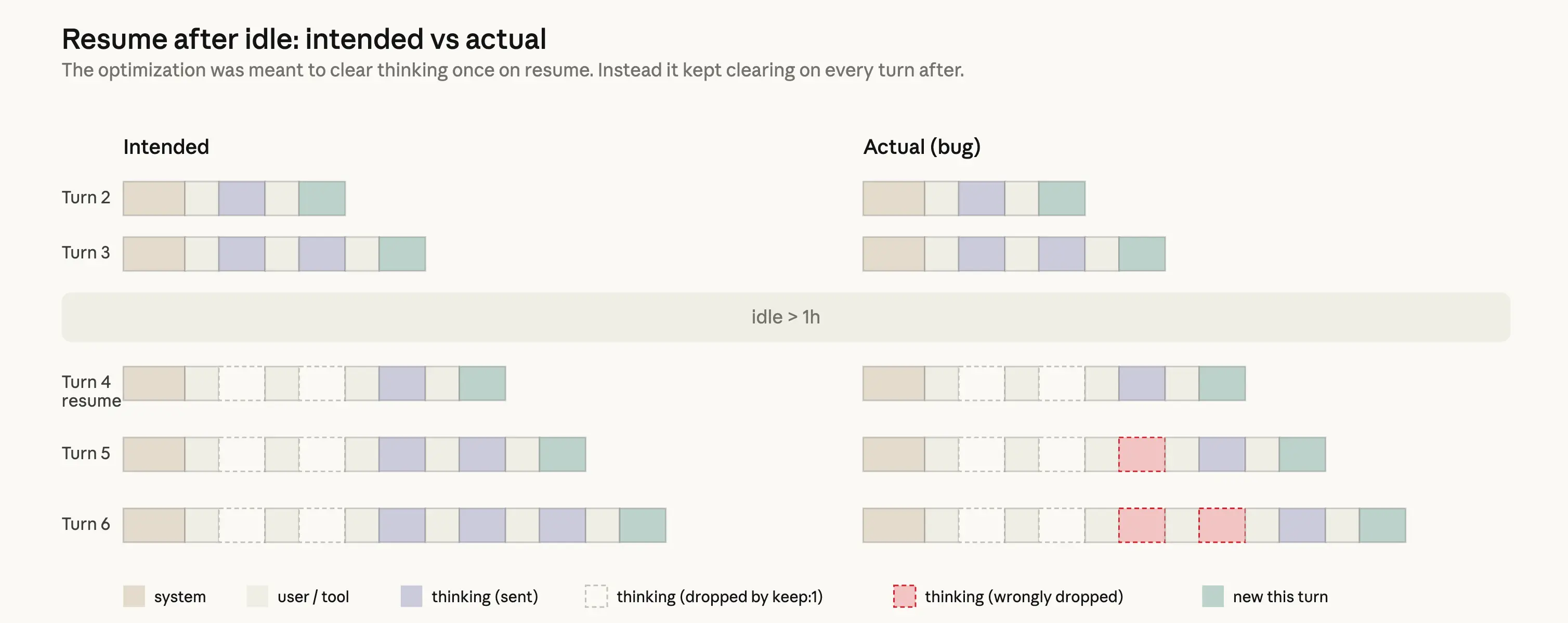
On March 26, we shipped a change to clear Claude’s older thinking from sessions that had been idle for over an hour, to reduce latency when users resumed those sessions. A bug caused this to keep happening every turn for the rest of the session instead of just once, which made Claude seem forgetful and repetitive. We fixed it on April 10. This affected Sonnet 4.6 and Opus 4.6. (View Highlight)
On April 16, we added a system prompt instruction to reduce verbosity. In combination with other prompt changes, it hurt coding quality, and was reverted on April 20. This impacted Sonnet 4.6, Opus 4.6, and Opus 4.7. (View Highlight)
Because each change affected a different slice of traffic on a different schedule, the aggregate effect looked like broad, inconsistent degradation. While we began investigating reports in early March, they were challenging to distinguish from normal variation in user feedback at first, and neither our internal usage nor evals initially reproduced the issues identified. (View Highlight)
In general, the longer the model thinks, the better the output. Effort levels are how Claude Code lets users set that tradeoff—more thinking versus lower latency and fewer usage limit hits. As we calibrate effort levels for our models, we take this tradeoff into account in order to pick points along the test-time-compute curve that give people the best range of options. In the product layer, we then choose which point along this curve we set as our default, and that is the value we send to the Messages API as the effort parameter; we then make the other options available via /effort. (View Highlight)
In our internal evals and testing, medium effort achieved slightly lower intelligence with significantly less latency for the majority of tasks. It also didn’t suffer from the same issues with occasional very long tail latencies for thinking, and it helped maximize users’ usage limits. As a result, we rolled out a change making medium the default effort, and explained the rationale via in-product dialog. (View Highlight)
Soon after rolling out, users began reporting that Claude Code felt less intelligent. We shipped a number of design iterations to make the current effort setting clearer in order to alert people they could change the default (notices on startup, an inline effort selector, and bringing back ultrathink), but most users retained the medium effort default. (View Highlight)
When Claude reasons through a task, that reasoning is normally kept in the conversation history so that on every subsequent turn, Claude can see why it made the edits and tool calls it did. (View Highlight)
On March 26, we shipped what was meant to be an efficiency improvement to this feature. We use prompt caching to make back-to-back API calls cheaper and faster for users. Claude writes the input tokens to the cache when it makes an API request, then after a period of inactivity the prompt is evicted from cache, making room for other prompts. Cache utilization is something we manage carefully (more on our approach). (View Highlight)
The design should have been simple: if a session has been idle for more than an hour, we could reduce users’ cost of resuming that session by clearing old thinking sections. Since the request would be a cache miss anyway, we could prune unnecessary messages from the request to reduce the number of uncached tokens sent to the API. We’d then resume sending full reasoning history. To do this we used the clear_thinking_20251015 API header along with keep:1. (View Highlight)
The implementation had a bug. Instead of clearing thinking history once, it cleared it on every turn for the rest of the session. After a session crossed the idle threshold once, each request for the rest of that process told the API to keep only the most recent block of reasoning and discard everything before it. This compounded: if you sent a follow-up message while Claude was in the middle of a tool use, that started a new turn under the broken flag, so even the reasoning from the current turn was dropped. Claude would continue executing, but increasingly without memory of why it had chosen to do what it was doing. This surfaced as the forgetfulness, repetition, and odd tool choices people reported. (View Highlight)
Because this would continuously drop thinking blocks from subsequent requests, those requests also resulted in cache misses. We believe this is what drove the separate reports of usage limits draining faster than expected. (View Highlight)
Two unrelated experiments made it challenging for us to reproduce the issue at first: an internal-only server-side experiment related to message queuing; and an orthogonal change in how we display thinking suppressed this bug in most CLI sessions, so we didn’t catch it even when testing external builds. (View Highlight)
This bug was at the intersection of Claude Code’s context management, the Anthropic API, and extended thinking. The changes it introduced made it past multiple human and automated code reviews, as well as unit tests, end-to-end tests, automated verification, and dogfooding. Combined with this only happening in a corner case (stale sessions) and the difficulty of reproducing the issue, it took us over a week to discover and confirm the root cause. (View Highlight)
Our latest model, Claude Opus 4.7, has a notable behavioral quirk relative to its predecessor: as we wrote about at launch, it tends to be quite verbose. This makes it smarter on hard problems, but it also produces more output tokens. (View Highlight)
A few weeks before we released Opus 4.7, we started tuning Claude Code in preparation. Each model behaves slightly differently, and we spend time before each release optimizing the harness and product for it. (View Highlight)
three issues have now been resolved as of April 20 (v2.1.116).
In this post, we explain what we found, what we fixed, and what we’ll do differently to ensure similar issues are much less likely to happen again.
We take reports about degradation very seriously. We never intentionally degrade our models, and we were able to immediately confirm that our API and inference layer were unaffected. (View Highlight)
When we released Opus 4.6 in Claude Code in February, we set the default reasoning effort to high.
Soon after, we received user feedback that Claude Opus 4.6 in high effort mode would occasionally think for too long, causing the UI to appear frozen and leading to disproportionate latency and token usage for those users. (View Highlight)

 (View Highlight)